
Yaarwin Colour Prediction
Every minute, Wingo draws a number from 0–9 and pays out on colours and numbers. This page shows the real payout table, the true probabilities behind it, and why the gap between those two is the whole story — the part the "sure-shot" channels charge you to ignore.
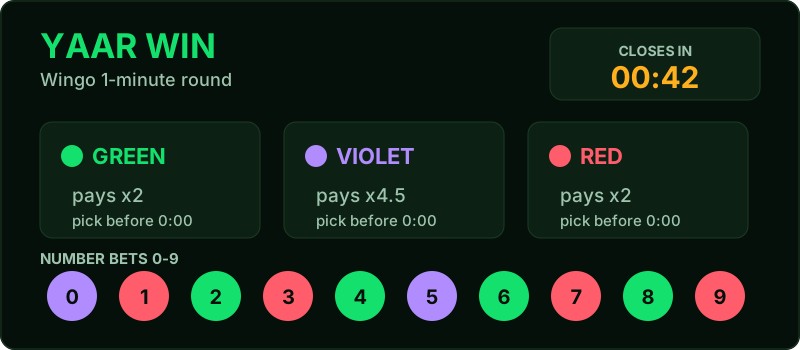
How a Wingo round works
A round opens, you place bets, the timer (1, 3, 5 or 10 minutes depending on the room) closes betting, and the platform's RNG draws one number from 0 to 9. Colours derive from the number: most digits are red or green, while 0 and 5 carry violet alongside a colour. You can bet a colour, a number, or big/small (5–9 vs 0–4). Winnings credit instantly; the next round opens immediately. That immediacy is the product — and the hazard.
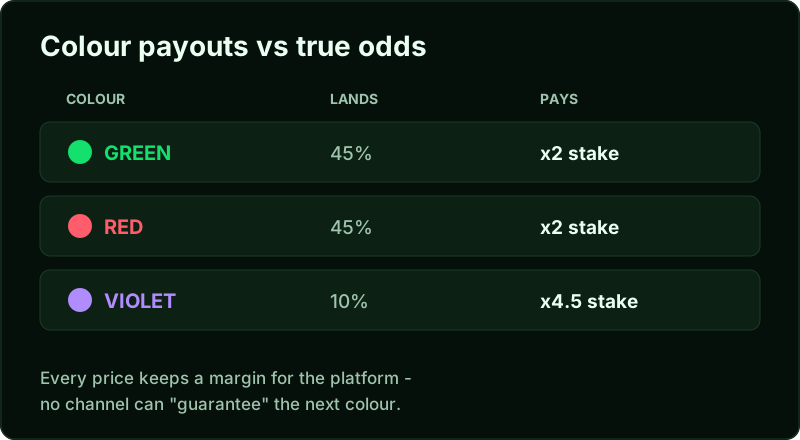
The payout table vs the true odds
| Bet | True chance | Fair payout would be | Actual payout | House keeps |
|---|---|---|---|---|
| Green / Red | ~45% of rounds | ~2.2x | 2x | ~9% |
| Violet | ~10% (digits 0 and 5) | 10x | 4.5x | ~55% |
| Exact number | 10% | 10x | 9x | 10% |
| Big / Small | 50% | 2x | ~1.95x | ~2.5% |
Read the last column once more. Every bet pays less than its true odds — that margin is the platform's income, identical in kind to any casino game in the world. It doesn't mean rounds are rigged; the draw can be perfectly random and the house still wins on volume, because the prices are set in its favour. Violet looks generous at 4.5x and is by far the worst-priced bet on the board.
Why no one can predict the next colour
The draw is server-side RNG. There is no pattern to read, no "due" colour, and no insider feed reaching a Telegram admin. The channels work a different game: post predictions to thousands of people, screenshot the wins, delete the losses, charge for "VIP". With a 45% chance per colour call, every channel gets impressive streaks by accident — survivorship does the marketing. If someone truly knew the next result, selling it to you at ₹500 a month would be the strangest possible use of that knowledge.
Anyone selling Yaar Win predictions, "hash decoders" or modded APKs is running a con on top of a gamble. The real or fake page covers how those cons end.
Why streaks feel meaningful — and aren't
Watch any Wingo room for twenty minutes and you'll see five reds in a row, and you'll feel — physically feel — that green is "due". That instinct is the gambler's fallacy, and it's the engine of every losing system. Independent draws have no memory: after five reds, green's chance is the same ~45% it always was. The platform's interface leans into the illusion by charting recent results prominently, because players who bet against streaks bet more. Knowing the chart is decoration, not data, is worth more than any paid prediction — it's the difference between choosing your stake and having it chosen for you.
"Strategies" — what survives contact with the maths
Martingale (double after every loss) is the strategy every channel eventually sells. It converts many small wins into occasional total wipeouts: seven reds in a row needs 128x your base stake on the table, and seven-streaks happen routinely at 45%. Flat staking — same small bet every round — doesn't beat the edge either; nothing does. What it actually does is slow your loss rate to the house margin and keep a session survivable, which is the only honest goal: with ~9% kept per colour bet, a flat-staking bankroll erodes gently instead of detonating. That, plus the big/small bet's thinner ~2.5% margin, is as far as real "strategy" goes in this game.
A worked example — what the edge does to ₹1,000
Numbers make the margin real. Stake ₹50 flat on a colour, every round, with ₹1,000. Each bet's expected return is about ₹45.5 — the ~9% margin claims roughly ₹4.5 per round on average. Twenty rounds in, expected loss sits near ₹90; after a hundred rounds (under two hours in the 1-minute room), around ₹450 of the bankroll is statistically gone.
You won't feel it happening, because individual rounds win constantly — 45% of them — and a few streaks will have the balance above ₹1,000 along the way. The drift only shows in the ledger afterwards. Run the same hundred rounds on big/small (~2.5% margin) and the expected loss drops to about ₹125: same game, same evening, a quarter of the cost — which is the entire practical content of "strategy" in this genre.
The other rooms rhyme. K3's middle-total bets and 5D's positional bets carry their own margins, generally fatter than big/small and thinner than violet. The room doesn't matter as much as the principle: every price on every board is set below true odds, and the only variable you control is how expensive your seat is.
If you play, play like this
- Set the budget before opening the lobby — an amount whose loss changes nothing about your week.
- Prefer the thin-margin bets — big/small and straight colours. Skip violet; its price is the worst on the board.
- Withdraw wins immediately. Money left in the wallet replays itself; the withdrawal loop takes minutes once your bank is bound.
- Stop at the budget, not at the streak. One-minute rounds make "one more" structural. The responsible gaming page has the limit checklist worth using.
Ready to see a round?
If the maths above reads acceptable to you as entertainment pricing, you now know more than most players ever bother to learn. The register guide sets your account up correctly (invite code at signup, bank bound early), the download page covers the APK, and the rooms run around the clock.
Colour prediction FAQ
Is Wingo on Yaar Win rigged?
It doesn't need to be. The payouts are priced below true odds, so the platform profits from honest randomness. That's the casino model, not a malfunction.
What's the best bet on the board?
Big/small keeps the thinnest house margin (~2.5%). Violet is the worst (~55%). None are profitable long-run; some lose slower.
Do colour patterns repeat?
Each draw is independent. Streaks happen because randomness produces streaks — they carry zero information about the next round.
Can I practice without money?
Watch rounds without betting — the lobby shows live results. Ten minutes of watching the result feed teaches the rhythm better than any tutorial.